German Shepherd-Husky Mix: Complete Shepsky Guide to Size, Temperament, Exercise, Grooming, Health, Lifespan, Training

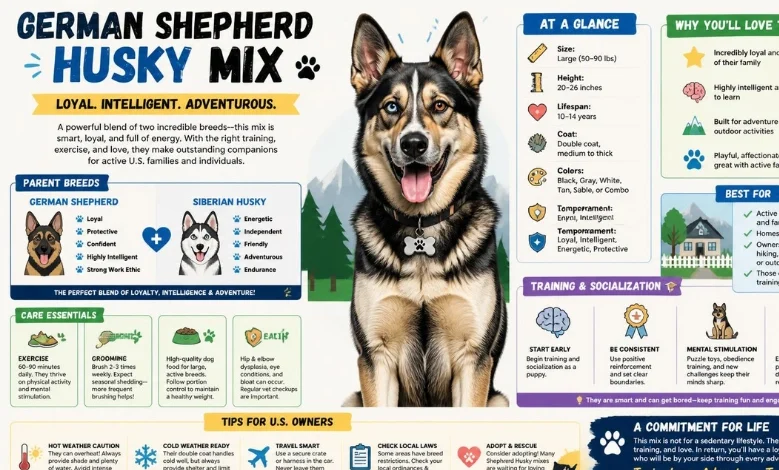
The German Shepherd-Husky mix, often called a Shepsky or Gerberian Shepsky, combines two working breeds known for energy, intelligence, and strong family bonds. Because this is a crossbreed without one fixed breed standard, size, coat, eye color, and temperament can vary considerably from dog to dog. For U.S. owners, the biggest question is whether your daily routine can handle the exercise, training, shedding, and supervision this dog often needs.
Quick answer: A Shepsky is a cross between a German Shepherd Dog and a Siberian Husky. Expect an athletic, medium-to-large dog with high activity needs, a shedding double coat, plenty of intelligence, and a personality that may range from outgoing to watchful. Active, training-focused homes are usually the strongest fit.
| Key fact | What to expect |
| Common names | Shepsky, Gerberian Shepsky, Husky Shepherd |
| Parent breeds | German Shepherd Dog and Siberian Husky |
| Typical adult size | Often about 40–90 pounds and roughly 20–26 inches tall, with substantial individual variation |
| Expected lifespan | Commonly around 10–14 years |
| Energy level | High |
| Coat | Usually a dense double coat with regular shedding |
| Training needs | Consistent reward-based training and early socialization |
| Good fit for | Active owners with time for daily physical and mental activity |
| Main considerations | Shedding, exercise, escape behavior, prey drive, heat safety, and inherited health risks |
Published size estimates differ because mixed-breed dogs can fall anywhere between, or sometimes beyond, common parental ranges. PetMD describes many Shepskies around 40–60 pounds, while other breed guides report a wider range that reaches about 90 pounds. That uncertainty is more useful to understand than treating any single number as a breed standard.
Key takeaways
- A Shepsky is usually smart, energetic, athletic, and strongly attached to its household.
- Individual temperament is less predictable than it is within an established pure breed.
- Heavy shedding should be expected because both parent breeds have double coats.
- Daily physical activity should be paired with training, scent work, puzzles, or other mental tasks.
- Early socialization matters, especially around children, strangers, dogs, cats, and smaller pets.
- Prospective owners should investigate health testing on both sides of the dog’s family.
- Homes in hot parts of the United States need a summer exercise and cooling plan.
What Is a Shepsky, and Why Can One Dog Differ So Much From Another?
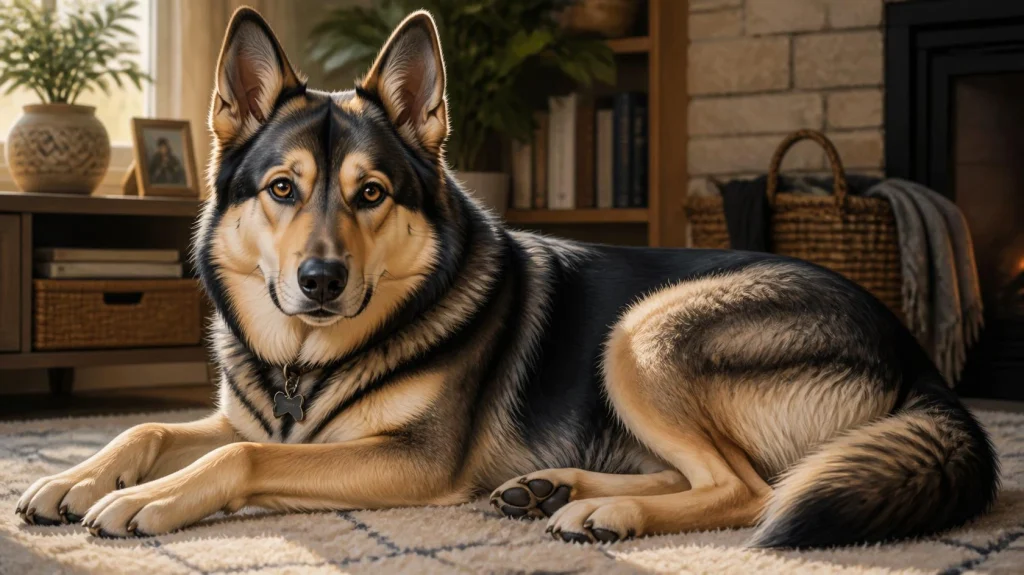
A Gerberian Shepsky is the offspring of German Shepherd and Siberian Husky ancestry, but it is not an AKC-recognized breed with a uniform standard. That means one dog may look strongly Shepherd-like while another inherits more Husky features. Even puppies from the same litter can differ in build, coat, eyes, behavior, and adult size.
The parents also bring somewhat different social tendencies to the mix. German Shepherd Dogs are commonly confident, trainable, and more reserved with unfamiliar people, while Siberian Huskies are generally social and have a strong instinct to run. A Shepsky can inherit either side strongly or show a mixture that changes as the dog matures.
That variability is why prospective owners should evaluate the individual dog rather than buying the label. Spend time with an adult rescue dog before adoption when possible, and ask about both parents if you are considering a puppy. Dailiest’s Pets section can also serve as a starting point for related pet-care reading.
German Shepherd-Husky Mix Size and Appearance
Most Shepskies mature into medium-to-large athletic dogs, although published weight estimates are broad. PetMD places many around 40–60 pounds, while other established breed guides describe dogs from the mid-30s into the 80- or 90-pound range. The size of both parents is usually a better clue to a puppy’s eventual build than a generic online average.
German shepherd-husky mixes with upright ears, an athletic frame, a substantial muzzle, and a dense coat are common, but none are guaranteed in the same combination. Eyes may be brown or blue, and some dogs can have differently colored eyes. Coat colors can include black, gray, sable, tan, white, red, or combinations inherited from either family line.
The broad range matters when you are planning for crates, vehicles, fencing, and veterinary costs. A 45-pound adult and an 85-pound adult create different space and handling demands even though both may be called Shepskies. Look at the dog in front of you rather than assuming every cross will mature to the same size.
Temperament: Loyal Companion or Too Much Dog?
A well-socialized Shepsky can be affectionate, playful, observant, and deeply connected to its family. Intelligence is rarely the limiting factor because both parent breeds were developed to work and solve problems. The challenge is that intelligence can come with independence, drive, and a willingness to invent entertainment when the household provides too little structure.
There is no sound basis for assuming every Shepsky will be aggressive or naturally protective. Temperament varies with genetics, early development, training, experiences, health, and the individual dog’s personality. PetMD specifically cautions that the absence of a breed standard makes firm predictions about this cross difficult.
Families with children can succeed with this mix, but energy and body size deserve attention. An excited young dog can knock down a small child without intending harm, so adults should supervise interactions and teach both dog and child appropriate boundaries. Calm introductions and reward-based socialization are more useful than expecting breed ancestry to determine behavior automatically.
Exercise and Training Need to Be Part of Daily Life
Both sides of this cross come from working backgrounds, so a quick bathroom walk rarely provides enough engagement for a healthy young adult. Shepskies tend to do better when physical exercise is spread across the day and paired with tasks that make them think. Walking, hiking, controlled running, fetch, nose work, obedience, food puzzles, and agility-style games can all provide useful outlets.
Training should start early and rely on clear, consistent rewards rather than intimidation. Short sessions can teach recall, leash manners, settling, impulse control, and reliable responses around distractions. Early socialization also helps a puppy learn that unfamiliar people, environments, dogs, sounds, and handling are ordinary parts of life.
A practical routine might include:
- A purposeful morning walk with time to sniff.
- A brief reward-based training session before breakfast.
- A food puzzle, scent game, or safe chew during quiet time.
- A second active outing later in the day.
- Fetch, obedience, or another interactive game in the evening.
- Planned rest so a young dog also learns how to settle.
Escape prevention deserves special attention because Siberian Huskies have a strong running instinct. Secure fencing, leash habits, identification, and microchipping are sensible safeguards for an athletic dog with curiosity and endurance. Owners concerned about wandering can also read Dailiest’s guide to dog GPS collars for another layer of location awareness.
Grooming, Shedding, and U.S. Heat Safety
If loose hair bothers you, this mix can be a difficult roommate. German Shepherd Dogs and Siberian Huskies both carry double coats, and Shepskies commonly shed throughout the year, with heavier periods as the undercoat is released. Regular brushing helps remove loose hair, prevent packed undercoat, and keep the skin easier to inspect.
Shaving a healthy double coat for summer is generally not recommended. The coat contributes to temperature regulation, while routine grooming removes loose undercoat and helps air move through healthy fur. AKC guidance recommends shade, fresh water, reduced activity during the hottest parts of the day, and close observation for overheating instead.
That advice matters across much of the United States, especially during humid summers and heat waves. Schedule harder exercise for cooler morning or evening hours, provide constant water, and avoid pushing a dog that is slowing down or panting excessively. Thick- or double-coated dogs can be more vulnerable to overheating during strenuous activity, so climate should shape the daily routine.
Health Risks and Expected Lifespan
PetMD gives a typical Shepsky lifespan of about 10–14 years, although no prediction can guarantee how long an individual dog will live. Health problems associated with the parental lines can still appear in mixed offspring. Concerns discussed by veterinary sources include hip dysplasia, degenerative myelopathy, and inherited eye disorders such as cataracts or progressive retinal atrophy.
If you are working with a breeder, ask for documented health information rather than accepting a general assurance that both parents are healthy. The Orthopedic Foundation for Animals’ CHIC program publishes breed-specific screening information and makes participating dogs’ results available for review. A CHIC number confirms that the required screenings were completed and made public, but it does not mean every result was normal.
Useful questions before bringing a dog home include:
- What health testing was completed on each parent?
- Can you see the actual results rather than a verbal assurance?
- Has the puppy received age-appropriate veterinary care?
- What behavior and temperament have been observed in the parents?
- How was the puppy socialized during its first weeks?
- For a rescue dog, what is known about behavior around people and other animals?
Routine veterinary care should then be tailored to the individual dog’s age, body condition, activity, and medical history. Nutrition also needs to fit the dog’s actual size rather than the breed label alone. A veterinarian can help set appropriate feeding, preventive care, and exercise plans as the dog matures.
Is a Shepsky a Good Fit for Your Home?
This cross tends to suit people who enjoy an active schedule and want training to be an ongoing part of dog ownership. Apartment living is possible for some individuals if their activity and enrichment needs are met outside the apartment. A large backyard can help, but it does not replace walks, training, social interaction, or supervised exercise.
Homes with cats or small pets need a more individual assessment because prey drive can vary. Introductions should be slow and supervised, and a dog with a history of intense chasing may not be a safe match for small animals. If your household includes cats, Dailiest’s Litter-Robot 3 and 4 comparison is another pet-care resource for managing the feline side of a multi-pet home.
A Shepsky may suit you if you:
- Want an active companion for walks, hikes, games, or dog sports.
- Have time for daily training and mental enrichment.
- Can tolerate frequent shedding and regular brushing.
- Are willing to manage leashes, fencing, and escape prevention carefully.
- Can adjust outdoor activity during hot weather.
- Are prepared for the costs and responsibilities of a medium-to-large dog.
A different dog may be easier if you prefer low exercise needs, minimal shedding, or a highly predictable adult temperament. The striking wolf-like appearance should come after lifestyle compatibility in your decision. Choosing an adult rescue can make size, coat, and established behavior easier to evaluate before you commit.
The Bottom Line Before You Bring One Home
A German shepherd-husky mix can be a rewarding companion for an owner who enjoys activity, training, and close involvement with a dog. Its biggest strengths, namely intelligence, endurance, and drive, are also the qualities that make poor lifestyle matches difficult. Before adopting or buying, meet the individual dog, review available health information, and decide whether you can provide the exercise, structure, grooming, and veterinary care it may need for the next decade or longer.
Frequently Asked Questions
Is a German Shepherd-Husky mix good for a first-time owner?
It can work, but this cross is often easier for someone who already understands energetic working dogs. The combination of exercise demands, training needs, shedding, strength, and possible independence can create a steep learning curve. A first-time owner who has strong professional training support and enough daily time may still succeed.
How much exercise does a Shepsky need?
Plan for substantial daily activity rather than relying on a short neighborhood walk. Healthy adults often benefit from multiple physical sessions plus training, scent work, puzzles, or interactive play. Puppies and dogs with medical conditions need age- and health-appropriate activity, so ask your veterinarian before starting demanding running or endurance exercise.
Do Shepskies shed a lot?
Yes, regular shedding is a realistic expectation because both parental breeds have dense double coats. Loose undercoats can increase during seasonal coat changes, and warmer climates may affect shedding patterns. Brushing several times each week can make the coat easier to manage, while shaving is generally discouraged for a healthy double-coated dog.
Are Shepskies good with children and other dogs?
Many can live happily with children and other dogs when socialized, trained, and supervised appropriately. Size and excitement can be a bigger issue around small children than deliberate aggression. Compatibility with other dogs also depends on the individual, so controlled introductions are more reliable than assumptions based on the mix’s name.