Infraction Definition in U.S. Law: The Complete Guide to Its Meaning, Common Examples, Penalties, Legal Consequences, and Key Differences

Last Updated on September 15, 2026 by Muhammad Binyameen
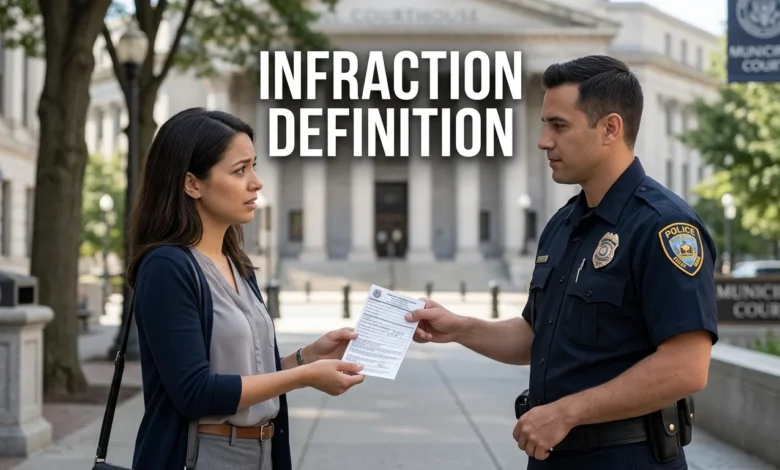
Short answer: An infraction is a minor violation of a law, rule, ordinance, or regulation. In many U.S. state systems, it is the lowest-level offense and is usually punished with a fine rather than jail, but the exact classification, penalties, and court rights depend on the jurisdiction and the specific law involved.
If you received a ticket or saw the word “infraction” on a court document, you may wonder whether it means you committed a crime. The answer isn’t the same everywhere in the United States because federal and state laws classify minor offenses differently. Understanding the infraction definition, therefore, requires looking at both the basic meaning and the law of the jurisdiction involved.
Key Takeaways
- An infraction generally means a minor violation of a law, regulation, ordinance, or rule.
- Infractions are usually less serious than misdemeanors and felonies.
- Many state infractions are punishable by fines rather than jail.
- Federal law has its own classification and can label an offense carrying no more than five days of imprisonment as an infraction.
- Traffic offenses are among the most familiar examples, although the exact classification depends on state and local law.
- An infraction does not automatically mean the same thing for criminal records, driving records, court rights, or penalties in every state.
What Does Infraction Mean?
In ordinary English, an infraction is a violation or breach of a rule, law, agreement, or obligation. The legal meaning follows the same basic idea but usually refers to a relatively minor offense. Common legal examples can include certain speeding offenses, parking-related violations, or other low-level breaches of local or state rules.
The key word is minor, but that doesn’t mean you should ignore an infraction. A citation can still require payment, a court response, or another action by a stated deadline. Failing to address the citation can sometimes create consequences more serious than the original violation.
Infraction Definition in U.S. Law
No single state-law definition covers every infraction across the United States. States and local governments determine how many offenses they classify, what penalties apply, and whether an offense is criminal or civil. This is why two similar acts can be classified differently depending on where they occur.
Federal law adds another important distinction. Under 18 U.S.C. § 3559, an otherwise unclassified federal offense is categorized as an infraction when the maximum authorized imprisonment is five days or less, or when no imprisonment is authorized. This federal definition means it is inaccurate to say that an infraction can never involve possible confinement anywhere in the United States.
Federal law also uses the broader term “petty offense.” Under 18 U.S.C. § 19, that term can include certain Class B misdemeanors, Class C misdemeanors, and infractions, subject to the statutory fine requirement. As a result, “petty offense” and “infraction” are related federal concepts but are not automatically interchangeable.
Common Examples of Infractions
Traffic violations are probably the most familiar examples of infractions, but the exact list depends on the state or municipality. California courts, for example, identify traffic offenses such as speeding, cell-phone violations, expired vehicle registration, and certain equipment violations as infractions. California also recognizes non-traffic infractions involving some local rules and minor state-law violations.
Examples that some jurisdictions may classify as infractions include the following.
- Speeding
- Running a stop sign or red light
- Certain parking violations
- Expired vehicle registration
- Some cell-phone or distracted-driving violations
- Certain equipment violations
- Littering
- Violating some noise ordinances
- Violating some animal-control or leash rules
- Certain local public-space ordinance violations
These examples should not be treated as a nationwide classification chart. An act listed as an infraction in one place may be handled as a civil violation, misdemeanor, municipal offense, or another category somewhere else. The statute, ordinance, or citation governing the specific conduct determines its actual legal classification.
Infraction vs. Misdemeanor vs. Felony
An infraction is generally placed at the low end of the offense-severity scale, while misdemeanors and felonies carry more serious potential consequences. However, state classification systems are not perfectly uniform, so use broad comparisons as a starting point rather than a substitute for local law. Federal law, for example, bases its classifications largely on the maximum authorized term of imprisonment.
| Classification | General level | Typical consequence | Possible jail or prison? |
|---|---|---|---|
| Infraction | Lowest/minor level | Usually a fine or other limited penalty | Usually no jail under many state systems; federal classification can include up to 5 days |
| Misdemeanor | More serious | Fines, probation, and potentially jail | Yes |
| Felony | Most serious category | Larger penalties and potentially lengthy imprisonment | Yes |
Under federal classification rules, offenses punishable by more than one year are felonies. Federal misdemeanors are divided into classes covering offenses with maximum imprisonment ranging from more than five days through one year, while the infraction category covers five days or less or no authorized imprisonment. State definitions may use different terminology, thresholds, and sentencing structures.
Is an Infraction a Crime?
Whether an infraction is technically considered a crime depends on the jurisdiction. California courts describe non-traffic infractions as crimes but identify them as the least serious type of offense, while New York expressly states that a traffic infraction is not a crime. Those examples show why a nationwide statement such as “every infraction is criminal” or “no infraction is criminal” would be misleading.
Virginia offers another example of jurisdiction-specific terminology. Its vehicle code defines a “traffic infraction” as a violation punishable under the relevant traffic statute that is neither a felony nor a misdemeanor. The practical question is therefore not simply what the word infraction means in general, but how the particular jurisdiction defines the offense shown on your citation.
What Are the Penalties for an Infraction?

A monetary fine is the most common consequence associated with an infraction. Additional costs, assessments, traffic-related consequences, or administrative requirements may apply depending on the law involved. You can’t determine the amount from the word “infraction” alone because fines are set by individual statutes, schedules, courts, and jurisdictions.
Depending on the offense and jurisdiction, possible consequences may include:
- A monetary fine
- Court fees or statutory assessments
- Points on a driving record
- Traffic-school requirements or eligibility
- Community service in some circumstances
- Correcting an equipment or registration problem
- Increased consequences if the citation is ignored
- Other administrative consequences authorized by local law
California illustrates how the details can vary even within a familiar infraction system. California court guidance states that infractions generally do not carry jail time, while traffic violations that add points to a DMV record may affect automobile insurance costs. The same guidance also warns that ignoring certain citations can result in additional penalties, collections, or other enforcement action.
Can You Go to Jail for an Infraction?
For many state-law infractions, jail is not an authorized punishment for the underlying offense. California, for example, states that infractions are not punishable by imprisonment, and Virginia distinguishes traffic infractions from misdemeanors and felonies. Someone dealing with a state or local ticket should nevertheless check the law printed on the citation rather than assuming every state follows exactly the same rule.
Federal law is the important exception to overly broad “no jail” explanations. The federal classification statute places offenses carrying no more than five days of authorized imprisonment in the infraction category, along with offenses for which no imprisonment is authorized. That distinction is one reason a reliable U.S. infraction definition needs to identify whether the matter is federal, state, or local.
Does an Infraction Go on Your Record?
The answer depends on what type of record you mean and where the violation occurred. A traffic infraction may affect a motor-vehicle or driving record without creating the same type of criminal record associated with a misdemeanor or felony. New York Courts, for example, explain that its traffic infractions are non-criminal offenses and do not create a criminal record.
Traffic records can still have practical effects even when the matter is not a criminal conviction. California Courts notes that a ticket adding a point to a DMV record can potentially increase insurance costs. Before assuming an infraction will either disappear completely or become a permanent criminal record, check the rules of the state and agency maintaining the relevant record.
What Happens When You Receive an Infraction Ticket?
Start by reading the citation carefully instead of relying on general information online. A ticket usually identifies the alleged violation, the court or agency handling the matter, and the deadline to respond. Depending on local procedure, it may also explain the fine or direct you to information about payment and contesting the citation.
A typical response may involve one of these actions:
- Pay the citation if you accept responsibility and the jurisdiction permits payment without appearing.
- Contest the ticket by following the instructions for requesting a hearing or trial.
- Request additional time when the court or agency allows extensions.
- Ask about payment options if you cannot afford the amount due.
- Correct an eligible violation when local law provides a procedure for doing so.
Paying a citation can have legal consequences, so understand what payment means before submitting it. California Courts, for example, explain that paying a traffic ticket amounts to accepting responsibility for the violation, while paying a non-traffic infraction generally resolves the case. Procedures elsewhere may differ, making the instructions from the court or agency handling your specific ticket the most relevant source.
What Happens If You Ignore an Infraction?
Ignoring a citation does not necessarily make a minor violation disappear. California court guidance warns that unpaid or unanswered citations can lead to increased fines, court fees, collections, and potentially additional consequences if you miss a required court appearance. The precise result depends on the jurisdiction, the ticket, and whether the person was legally required to appear.
Deadlines on official court documents should therefore be taken seriously even when the original offense seems minor. The same principle applies to other court notices, because failure to respond can create a separate procedural problem. For more context on responding to court obligations, read Dailiest’s guide to what happens if you miss jury duty.
Can You Fight an Infraction?
A person generally has a way to dispute a citation, although the procedure depends on the court and type of offense. California’s infraction guidance, for example, allows a cited person to contest an eligible ticket rather than simply pay it, and a judge may decide the matter. Anyone contesting a citation should follow the deadline and instructions provided by the particular court or agency.
The court procedure for a minor infraction may also be different from the procedure used for a more serious criminal charge. California states that infraction trials do not involve a jury, illustrating how procedural rights can vary with the classification of the case. More serious charges take a different path and begin with jury selection and voir dire questioning of potential jurors, a stage that has no equivalent in a routine infraction hearing.
Do You Need a Lawyer for an Infraction?
Many routine infractions can be handled through the court’s instructions, particularly when the issue is simply whether to pay or contest a fine. A person may nevertheless choose to speak with an attorney when the classification is unclear, the consequences could affect a license or employment, multiple charges are involved, or the citation may actually include a misdemeanor. The need for legal representation depends much more on the particular case than on the general definition of an infraction.
Court-appointed-lawyer rules also should not be generalized across every possible U.S. infraction. Many fine-only state proceedings do not provide the same right to appointed counsel as criminal charges that carry possible incarceration, and federal and state rules can differ. If a citation includes possible jail, a misdemeanor designation, or language you do not understand, checking the actual statute or consulting a lawyer licensed in that jurisdiction is safer than relying on the label alone.
Infraction vs. Violation: Are They the Same?
The words infraction and violation are sometimes used informally as synonyms, but legal systems can assign them different technical meanings. New York, for example, distinguishes a traffic infraction from a separate category called a “violation,” while federal law uses its own definitions for infractions and petty offenses. The wording on the governing statute therefore matters more than a dictionary synonym.
You may also encounter the phrase civil infraction, especially in traffic, municipal, regulatory, or administrative contexts. That label generally signals a non-criminal or civil enforcement framework, but the legal effect still depends on the jurisdiction that created the offense. Do not assume that every offense containing the word “infraction” has identical procedures, fines, or record consequences.
Why State and Local Law Matter So Much
California, New York, and Virginia demonstrate how the same general concept can be expressed differently. California recognizes infractions as the least serious type of offense and generally handles them without imprisonment, New York expressly treats traffic infractions as non-criminal, and Virginia defines a traffic infraction as neither a felony nor a misdemeanor. These differences are not contradictions; they reflect separate legal systems using their own classification rules.
For that reason, the most useful information on an actual ticket is usually the statute or ordinance number, the jurisdiction, and the issuing court or agency. Searching the exact legal provision can tell you more than searching for the term infraction on its own. When there is a conflict between a general online definition and the official information for your case, rely on the governing law and instructions from the appropriate court.
Frequently Asked Questions
What is the simplest infraction definition?
An infraction is a minor violation of a law, ordinance, rule, or regulation. It is generally less serious than a misdemeanor or felony and commonly results in a fine. The precise classification and consequences depend on federal, state, or local law.
Is a speeding ticket an infraction?
Many ordinary speeding violations are classified as traffic infractions, but the answer depends on the state and the circumstances. California lists speeding among violations commonly handled as traffic infractions, while New York also treats many speeding offenses as traffic infractions rather than crimes. More serious driving behavior can fall into a different offense category under applicable state law.
Is an infraction worse than a misdemeanor?
Generally, no. An infraction is normally a lower-level offense carrying less severe consequences than a misdemeanor. However, jurisdictions set exact classifications and penalties, so you should always check the specific statute.
Does an infraction mean you were arrested?
No, receiving an infraction citation does not by itself mean you were arrested. Minor infractions are commonly enforced through tickets or citations that tell the person how and when to respond. The procedure can differ when another offense, missed appearance, or separate enforcement issue is involved.
Will an infraction affect a background check?
It depends on the jurisdiction, the type of infraction, and the records searched in the background check. Some traffic infractions are expressly non-criminal, while driving violations can still appear in motor-vehicle records maintained by state agencies. Because record rules differ, the safest approach is to check the law and record system that applies to the particular offense.
Can an infraction become a misdemeanor?
Some conduct may be chargeable at different levels depending on the circumstances or the governing law. California courts note that some tickets can be charged as either infractions or misdemeanors, with the classification depending on factors such as the applicable law and situation. This is another reason to read the actual charge rather than assuming its seriousness from a brief description of the conduct.
Conclusion
The basic definition of an infraction is straightforward: it is a relatively minor violation of a law, ordinance, regulation, or rule. What becomes more complicated is determining whether the infraction is criminal or non-criminal, what penalties are possible, and what effect it can have on court or driving records. Those answers depend on the governing federal, state, or local law, so always check the citation and official rules for the jurisdiction involved.