Voir Dire Explained: How Jury Questioning Exposes Bias, Shapes Jury Selection, and Protects the Right to a Fair Trial

Last Updated on September 6, 2026 by Abdul Rehman
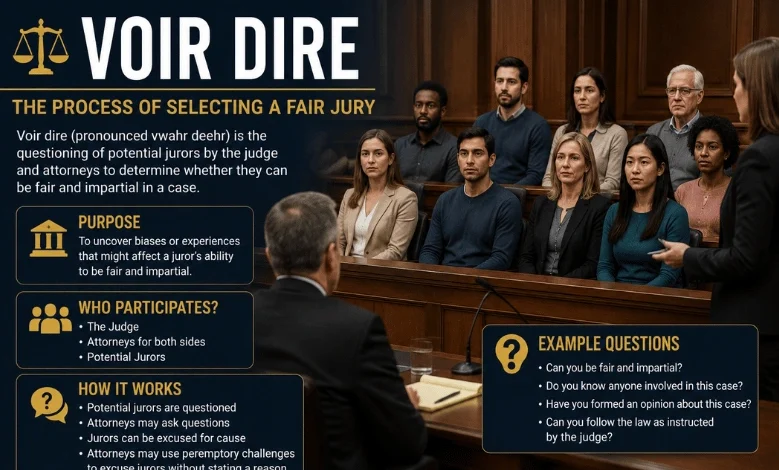
Short answer: Voir dire is the courtroom questioning of prospective jurors before a jury is seated. A judge, lawyers, or both use the questioning to uncover bias, conflicts, or other reasons someone may not be able to serve fairly. The answers help the court decide who can remain in the jury pool and who should be excused.
| Key point | What it means |
| Main U.S. use | Questioning prospective jurors before a jury is selected |
| Who asks questions? | The judge, attorneys, or both, depending on the court |
| Main purpose | To identify bias, conflicts, or an inability to be impartial |
| Challenge for cause | A request to excuse someone for a specific reason |
| Peremptory challenge | A limited strike that normally does not require a stated reason |
| Other legal use | Preliminary questioning of a witness, especially an expert |
The process matters because the goal is not to find jurors with no opinions or life experience. Courts need people who can listen to the evidence, follow the judge’s instructions, and decide the case fairly. Jury questioning is an important safeguard designed to help courts seat an impartial jury.
Key Takeaways
- Jury questioning is one part of the larger jury-selection process.
- Procedures differ among courts, judges, case types, and jurisdictions.
- A prospective juror may be removed for cause when there is a valid concern about fairness.
- Parties also receive a limited number of peremptory challenges under applicable rules.
- A peremptory strike cannot lawfully be used for prohibited discrimination.
- The same legal term can have other meanings involving witnesses or questions about admissibility.
What Does Voir Dire Mean?
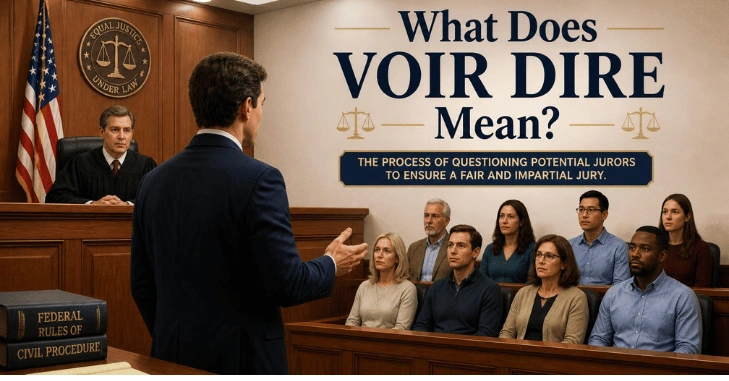
The term comes from legal French and is commonly understood to mean speaking the truth. In modern U.S. practice, it usually describes the examination of people being considered for jury service. Voir dire can also refer to the preliminary questioning of witnesses, especially experts.
That makes context important. If you hear the term before a U.S. jury trial, it will usually concern prospective jurors. In another procedural setting, the court may be examining whether a witness is qualified to testify. Readers interested in related legal topics can also browse Dailiest’s Law archive for more articles in this category.
How the Jury-Questioning Process Works
The exact sequence is not identical in every courtroom. Federal rules allow judges to manage examinations in various ways, and individual judges may establish their own procedures.
A typical process follows this general pattern:
- Prospective jurors enter the selection process. They may receive preliminary instructions and provide background information.
- The court begins questioning. The judge may ask the questions or permit attorneys to participate.
- Potential problems are identified. Answers may reveal bias, a connection to someone involved, or another concern about impartiality.
- Challenges are considered. The judge decides challenges for cause, while the parties may use available peremptory strikes.
- The remaining jurors are seated. Once selection ends, the chosen jurors are sworn in, and the case proceeds.
Federal Rule of Civil Procedure 47 allows the court to question prospective jurors itself or permit the parties or their lawyers to do so. Federal Rule of Criminal Procedure 24 provides a similar framework.
What Questions Can Prospective Jurors Expect?
Questions depend on the facts and legal issues involved in the case. A court may also use a written questionnaire before or during jury selection. Courtroom procedures can differ significantly from one judge or jurisdiction to another.
Common subjects can include:
- whether a juror knows a party, lawyer, witness, or another person connected to the case;
- previous jury service or experiences closely related to the dispute;
- opinions or personal experiences that might affect impartiality;
- whether the person can follow the law as the judge explains it;
- scheduling, hardship, or another issue affecting the person’s ability to serve.
For example, jury materials may include lists of parties and witnesses to help identify potential connections. Some courts also ask background questions before moving to case-specific issues.
A prospective juror does not need to guess which answer a lawyer wants. The purpose is to provide truthful information so the court can evaluate whether the person can decide the case fairly.
Challenge for Cause vs. Peremptory Challenge
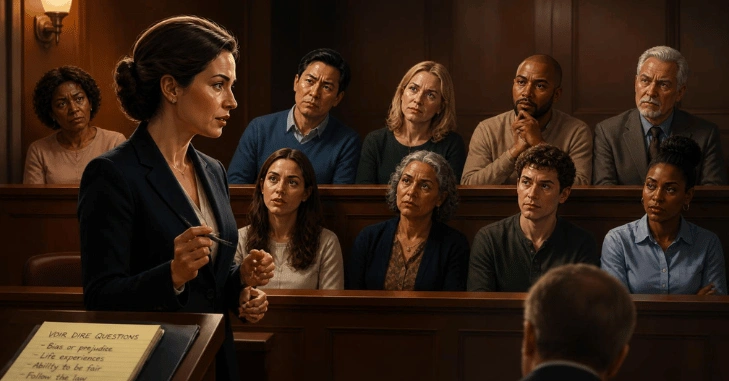
These two types of challenges work differently. A challenge for cause identifies a specific reason a prospective juror should not serve. Bias or an inability to remain impartial can support such a request. The judge decides whether the stated reason is sufficient.
A peremptory challenge normally allows a party to remove a limited number of prospective jurors without providing the same type of cause-based explanation. The number available depends on the type of case and the governing rules.
That discretion has constitutional limits. A party may object when a peremptory strike appears to be based on race, ethnicity, or gender. Such objections are commonly called Batson challenges, after the 1986 Supreme Court decision Batson v. Kentucky.
Federal Rules Show How the Numbers Can Differ
The federal system provides a useful example of why you should not assume that every jury trial follows the same rules or allows the same number of challenges.
| Federal case type | Peremptory challenges |
| Civil case | Generally 3 for each party |
| Criminal misdemeanor | 3 for each side |
| Criminal felony punishable by more than one year | 6 for the government and 10 jointly for the defendant or defendants |
| Federal capital case | 20 for each side |
The civil rule comes from 28 U.S.C. § 1870. Criminal challenge numbers are governed by Federal Rule of Criminal Procedure 24. Additional considerations may apply when there are multiple parties or alternate jurors.
If the court system itself interests you, Dailiest also has an article about pursuing an academic career in law.
How Long Does Jury Questioning Take?
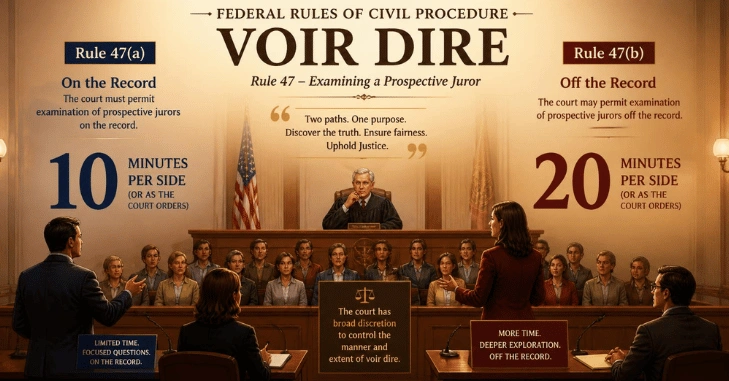
There is no single nationwide duration. The length depends on the case, the number of prospective jurors, issues that may create bias, local rules, and the judge’s selection method.
Court procedures show how much courtroom practice can differ. Some judges conduct most of the questioning themselves and invite follow-up questions from counsel. Others give lawyers a defined opportunity to question the panel.
A simple case with few disputed issues may require less examination than a complex or heavily publicized matter. Jurors should therefore follow the instructions and scheduling information provided by their own court rather than relying on a universal estimate.
Is It the Same as Jury Selection?
Not quite. Jury selection is the broader process, while the questioning stage is one part of it. Selection can also include challenges, excusals, the replacement of panel members, and the final seating and swearing-in of jurors.
That distinction explains why the two expressions are often used together but are not technically identical.
The practical details can matter in civil litigation as well as in criminal cases. Dailiest’s article on how Huntsville injury lawyers handle accident claims offers another look at the preparation involved in a civil legal matter.
The Term Can Mean Something Else Outside U.S. Jury Selection
The jury-selection meaning dominates U.S. usage, but it is not the only one. Courts may also use the term to refer to preliminary questioning of a witness, particularly an expert, to determine whether the person is qualified to testify.
In England and Wales, the expression can refer to a “trial within a trial,” in which a judge decides a preliminary issue, such as whether evidence is admissible. Australian legal usage can follow a similar approach. So, the safest interpretation always depends on the jurisdiction and courtroom context.
What to Remember Before Jury Service
If you receive a jury summons, follow the instructions from the court that summoned you. During questioning, listen carefully and answer candidly. The court needs accurate information, not a rehearsed “right” response.
For more plain-English legal reading, start with Dailiest’s Law section and its related legal articles.
Conclusion
Voir dire is an important part of the jury-selection process because it gives the court and attorneys an opportunity to identify potential bias, conflicts, personal experiences, or other circumstances that could affect a prospective juror’s ability to remain impartial. Although the basic purpose is straightforward, the exact procedure can vary between federal, state, civil, and criminal courts.
Understanding the difference between challenges for cause and peremptory challenges is also essential. A challenge for cause is based on a specific concern about a juror’s suitability, while a peremptory challenge allows a limited strike subject to important legal restrictions, including protections against discriminatory jury selection. For a closer look at this, see What Happens If You Miss Jury Duty? Understanding Penalties.
Frequently Asked Questions
It is a question-and-answer process used before a jury is finalized. The judge, attorneys, or both may question prospective jurors to identify reasons they may be unable to decide the case impartially.
It depends on the court. In federal civil and criminal proceedings, the judge may conduct the examination or permit attorneys to participate. A judge who leads the questioning may also consider additional appropriate questions proposed by counsel.
Yes. If an answer reveals a valid reason the person may not be impartial, a party can make a challenge for cause. The judge decides whether the challenge succeeds.
No. Removal through a peremptory challenge does not mean the juror did anything wrong, nor does it necessarily reflect on the person’s ability or integrity.
No. Federal civil and criminal rules differ, and individual courts can use different selection procedures within the limits of governing law. State court systems also have their own rules